Course description
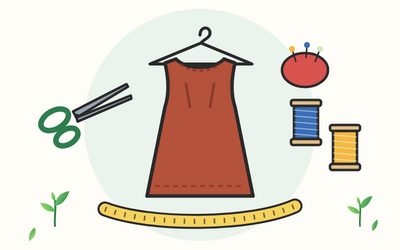
If you can use a sewing machine and you'd like to make clothes that fit you, this course takes you from your first pattern envelope to a wardrobe of garments you've made yourself: a skirt, a top with sleeves, a dress and a T-shirt.
You learn to measure your body, read a size chart and work out ease, so you choose the right size for each garment. You learn to read every part of a pattern, trace and blend between sizes, choose and buy fabric, and lay out, cut and mark accurately. You make a practice version called a toile and learn to read what it tells you, then make simple, reliable changes to the paper pattern. Each project adds new skills: darts, an invisible zip and a waistband; a facing and set-in sleeves; a centred zip, pockets and bias binding; and sewing knits on an ordinary machine. Every measurement is given in centimetres, with inches in brackets.
There are 10 sections and 50 written lessons, each with a worked example, common slips, questions people often ask and a short exercise to try, and each section ends with a short quiz. You follow Shiori, a school librarian in Kendal, and Gaukhar, a retired theatre costume maker who runs a Thursday evening sewing group, from January to September 2026. Every section has a practice pack with a worksheet, example answers and a cheat sheet, plus charts, checklists, diagrams and planners such as a measurement chart, a size and ease worksheet, a pattern symbols sheet, a fabric and notions planner, a fitting record and a project log.
What you'll learn
- Getting started with dressmaking: how dressmaking differs from the sewing you know, the kit you need and what can wait, setting up a safe workspace, and planning your first garments.
- Measuring your body: taking your measurements well, with or without a helper, a measurement chart in centimetres and inches, ease, and choosing your size from a size chart.
- Reading a sewing pattern: the envelope, the symbols on each piece, the instruction sheet, tracing and blending between sizes, and checking a pattern before you cut.
- Fabric, notions and cutting out: choosing fabric, working out how much to buy, interfacing, zips and thread, pre-washing, finding the grain, laying out, cutting and marking.
- Project 1, an A-line skirt: the order of work, darts, an invisible zip, a waistband with a buttonhole, and a neat hem.
- Fitting with a toile: making a practice version, reading wrinkles, lengthening and shortening, changing width, a simple full bust adjustment and recording your changes.
- Project 2, a woven top with sleeves: a lighter fabric, bust darts, a neck facing with understitching, and setting in a sleeve.
- Project 3, a shift dress: blending sizes from bust to hip, a centred zip, in-seam pockets, bias binding and levelling a hem.
- Sewing with knit fabrics: stretch and recovery, needles and stitches on an ordinary machine, a T-shirt with a neckband, and hems that don't go wavy.
- Finishing, care and your next clothes: French seams and bound seams, caring for and labelling your clothes, the rules to check if you sell them, and a final garment of your own choice.
Who it's for
Adults who can already thread and use a sewing machine and sew a straight seam, and who'd like to make their own clothes. If you're new to sewing, begin with Rootlet's Sewing for Beginners: Hand Sewing, Machine Sewing, Mending and Your First Makes, then come back to this course.
What this course is, and isn't
This is a home dressmaking course for clothes for adults. The patterns, size chart and measurements in the course are its own, made up for teaching, and the course doesn't recommend any pattern company or shop. The short lesson on selling clothes explains the main labelling rule and points you to the official guidance rather than giving legal advice. Shiori, Gaukhar and every other person in the course are fictional.