Compare with 1 courses
Raspberry Pi for Beginners: Home Projects with Python

Raspberry Pi for Beginners: Home Projects with Python

Set up a Raspberry Pi, learn Python and safe low-voltage electronics, and build a home room monitor that logs readings and shows them on a web page. 50 lessons.

£34.99

Learn more
Has discount
Expiry period Lifetime
Made in English
Last updated at Wed Nov 2026
Level
Beginner
Total lectures 60
Total quizzes 10
Total duration 10:46:00 Hours
Total enrolment 0
Number of reviews 0
Avg rating
Short description Set up a Raspberry Pi, learn Python and safe low-voltage electronics, and build a home room monitor that logs readings and shows them on a web page. 50 lessons.
Outcomes
  • Choose a Raspberry Pi model and the parts it needs, and install Raspberry Pi OS with Raspberry Pi Imager
  • Find your way round the desktop and the terminal, and keep your Pi updated and safe with good passwords
  • Write and run Python programs in Thonny, with decisions, loops, functions and files
  • Understand the GPIO pins, pin numbering, 3.3V logic and the current limits, and why 5V must never reach a GPIO pin
  • Build circuits on a breadboard with jumper wires and resistors, and read resistor colour codes
  • Control LEDs, traffic lights and a buzzer, and read buttons and a motion sensor, with gpiozero
  • Read the Pi's own temperature, log readings to a CSV file, summarise them and draw a simple chart
  • Run programs on a schedule or at start-up with cron and systemd, in outline
  • Serve a small web page on your home network with Python's standard library, and troubleshoot calmly
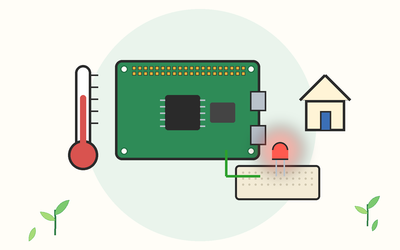
  • Build a home room monitor station that logs the Pi's own temperature, lights an LED when warm and shows its readings on a page
Requirements
  • No programming or electronics experience is needed: the course starts from the very beginning
  • A Raspberry Pi with a 40-pin GPIO header, a microSD card, the right power supply, and a screen, keyboard and mouse or another computer
  • For Sections 5 to 10, a low-voltage starter kit: a breadboard, jumper wires, LEDs, resistors, a push button, a buzzer and a motion sensor module

Learn something new every week

One short, practical tip each Thursday, plus news when new courses open. Free, and you can unsubscribe in one click.

We'll never share your email. See our privacy policy.