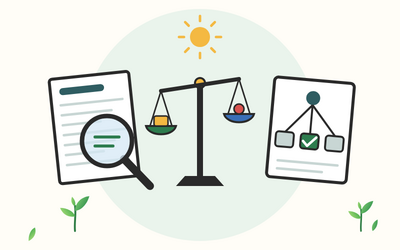
Course description
Whether you lead a team, work in an office or are looking for your next job, this course helps you think clearly, solve problems properly and make better decisions, at work and in everyday life.
You start by asking good questions and telling facts from opinions and assumptions. You learn to judge sources and evidence, including false information online and AI generated content, and to spot faulty reasoning and the thinking biases that trip all of us up. You read numbers and charts calmly and fairly. Then you work through problems step by step: defining the problem, finding its root cause with the 5 whys and a fishbone diagram, generating options, weighing them with a decision matrix and a pre-mortem, and presenting a clear recommendation. You also learn how to think well with others, and how to use these skills in interviews and assessments.
There are 10 sections and 50 written lessons, each with a worked example, common slips, questions people often ask and a short exercise to try, and each section ends with a short quiz. You follow Rosnah, a team leader at a made-up office supplies company, as she gets to the bottom of a rise in late orders and recommends a fix. Every section has a practice pack with a worksheet, an answer key and a cheat sheet, plus a thinking habits baseline, a question prompts card, a fact or opinion sorter, a source checking checklist, a faulty reasoning spotter card, a bias self-check card, a numbers and charts checklist, a problem statement template, a 5 whys and fishbone template, a decision matrix spreadsheet, a pre-mortem worksheet, a one-page recommendation template and a glossary. The final project takes a made-up community café's problem from evidence to recommendation, with a model answer to compare against.
What you'll learn
- What critical thinking is: what it is and isn't, why clear thinking matters at work and at home, quick and slow thinking, and a baseline of your own thinking habits.
- Good questions and clear information: clarifying and probing questions, facts, opinions, assumptions and inferences, hidden assumptions, noticing what's missing and checking claims in conversation.
- Sources and evidence: what counts as evidence, judging a source, false and misleading information online, the GOV.UK SHARE checklist, AI generated content and deepfakes, and weighing evidence that points different ways.
- Arguments and faulty reasoning: claims, reasons and evidence, the straw man, the false choice, the slippery slope, appeals to authority, correlation and cause, and building a sound argument of your own.
- Cognitive biases: confirmation bias, anchoring, sunk cost thinking, availability, overconfidence and groupthink, and simple ways to check yourself.
- Numbers and charts: reading numbers calmly, the mean, median and mode, percentages and percentage points, misleading charts and axes, small samples and fair comparisons.
- Defining problems and finding causes: pinning a problem down, writing a problem statement, root cause analysis with the 5 whys, the fishbone diagram and checking a cause before you act.
- Options and decisions: generating options, creative thinking techniques, weighted pros and cons, SWOT, the decision matrix, risk, reversibility, uncertainty and the pre-mortem.
- Thinking with others: psychological safety, challenge without conflict, avoiding groupthink, looking at a problem from different angles, a one-page recommendation and fairness in decisions.
- Using your skills and the final project: critical thinking in interviews and assessments, a weekly practice routine, and a final project on a made-up community café, with a complete model answer.
Who it's for
Office staff, team leaders and job seekers who want to question information, solve problems and make decisions with more confidence. You don't need any experience or any special knowledge.
What this course is, and isn't
This is an introduction to critical thinking and problem solving. It isn't a professional qualification, and it isn't legal, financial or medical advice. It uses widely known general methods, names no software or companies and describes tools by type. Public guidance, such as the GOV.UK SHARE checklist and Ofcom's explanation of deepfakes, is described as it read when the course was written. Rosnah and every other person, organisation and figure in the course are fictional.