Course description
If you can already use Python and pandas and you want to start building machine learning models, this course takes you from your first fitted line to a complete, carefully checked project, one clear step at a time.
You learn the workflow that every good model follows: prepare the data with pandas, keep some back for a fair check, train a model with scikit-learn, measure it properly and improve it without fooling yourself. You build linear regression, logistic regression, decision tree, k-nearest neighbours and random forest models, measure them with accuracy, precision, recall, the confusion matrix and regression errors, and use cross-validation, grid searches and pipelines to choose settings fairly. You also group data with k-means clustering, and you learn to check a model for bias, handle personal data with care and explain your results to people who aren't data specialists.
There are 10 sections and 50 written lessons, each with real code and its real output, a worked example, common slips, questions people often ask and a short exercise to try, and each section ends with a short quiz. You follow Tsegaye, a data analyst at a fictional leisure trust, as he predicts pool visitors and helps the membership manager decide which members to offer a friendly check-in call. Every section has a practice pack with made-up data files, starter scripts, finished solution scripts, expected output, a worksheet with an answer key and a cheat sheet. The final project gives you a new dataset, a brief, a full worked answer script and a sample write-up.
What you'll learn
- Getting started with machine learning: what machine learning is and isn't, the words you'll meet, setting up Python, pandas, scikit-learn and Jupyter, the workflow, and a first model in a few lines.
- Preparing data with pandas: exploring a new dataset, missing values, turning categories into numbers, making new features, and clean features and labels.
- Splitting data and keeping some back: why a model must be judged on data it hasn't seen, making a hold-out set, fair splits for time and for uneven classes, leakage, and baselines.
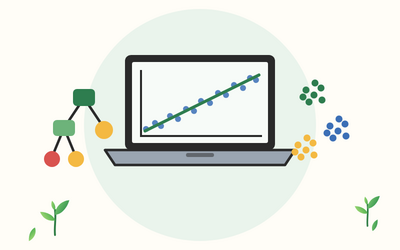
- Linear regression: how a fitted line works, fitting and reading one, several features, regression error measures, and where a straight line goes wrong.
- Classification models: probabilities and classes, logistic regression, decision trees, k-nearest neighbours and a fair comparison of all three.
- Evaluating models: accuracy and its limits, the confusion matrix, precision and recall, thresholds and the F1 score, and choosing the right measure for the job.
- Overfitting and cross-validation: overfitting and underfitting, validation sets, cross-validation, tuning settings with a grid search, and keeping the hold-out set untouched.
- Pipelines, preprocessing and random forests: pipelines that keep preparation fair, filling gaps and encoding text columns, random forests, feature importance and saving a model.
- Clustering and responsible machine learning: k-means clustering and choosing the number of groups, checking a model for bias, handling personal data with care, and explaining results in plain words.
- Final project: the Oddbarrow Veg Boxes model: a complete project on a new made-up dataset, from brief and first look to a final check and a write-up for the owner, with full worked answers.
Who it's for
Python learners and analysts who are comfortable with Python basics and with loading, cleaning and summarising data in pandas, and who want to take the next step into machine learning. No maths beyond everyday arithmetic is needed. If you're new to pandas, Python for Data Analysis: Clean, Analyse and Chart Real Data with pandas is the place to start, and if you're new to Python itself, begin with Python for Beginners: Write Real Programs from Scratch.
What this course is, and isn't
This is a practical introduction to machine learning with Python, pandas, NumPy, scikit-learn and matplotlib, using small, made-up datasets so you can see exactly what each model does. It isn't a course on deep learning or on building large language models, and it isn't legal advice about using personal data. Every code sample was run with the library versions named in Lesson 1.3. Tsegaye and every other person and organisation in the course are fictional.